
If the inspection fails
A failed finding should name the component. From there, the question is whether that component can be repaired or whether the tank, field, or cesspool has to be replaced. Failed septic inspection.
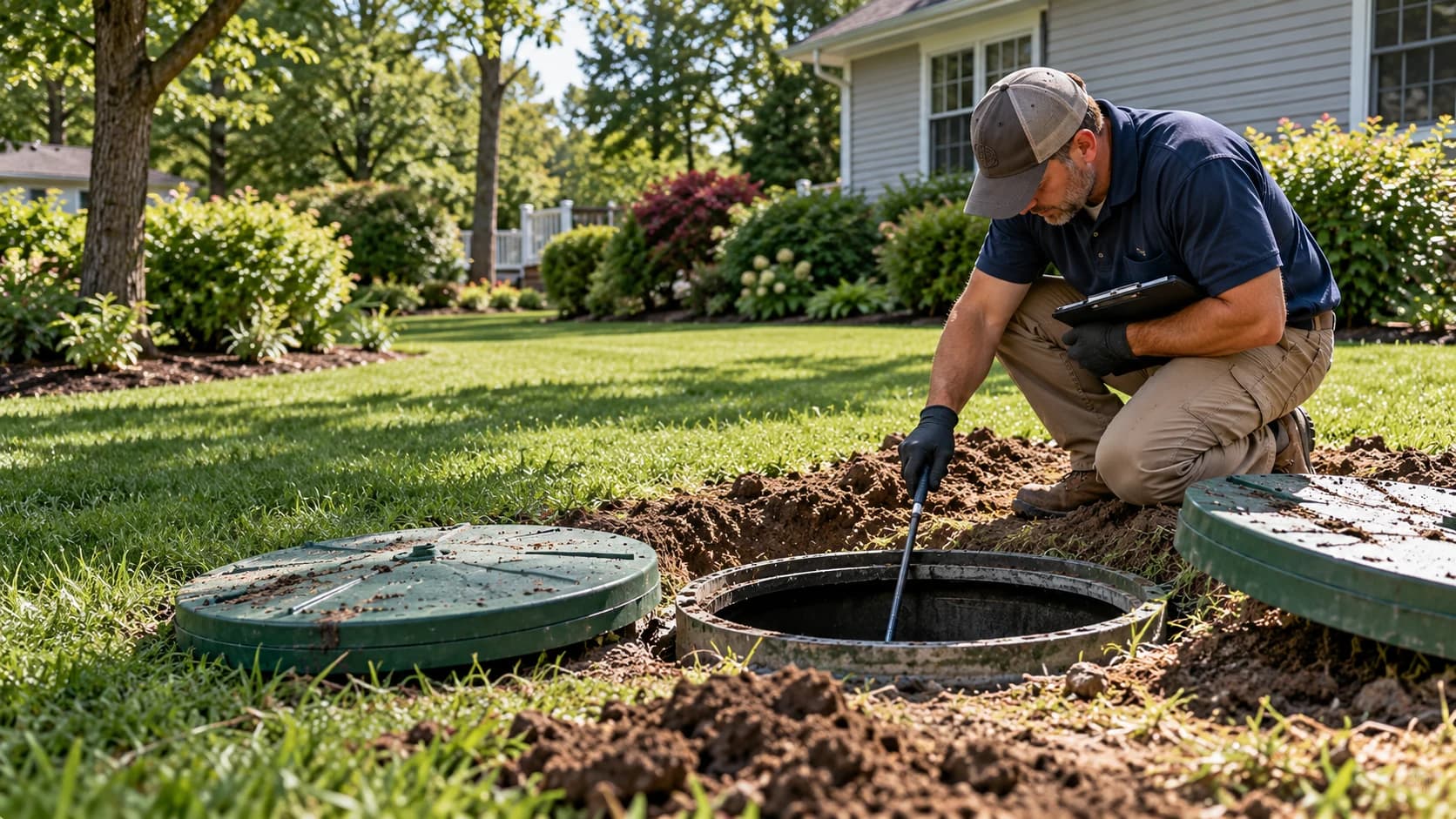
Before a home sale, an inspection can document whether the property has a septic tank or cesspool and the condition of accessible components. Backups, sewage odors, wet ground, or an unknown system history are also reasons to have the system evaluated.
A tank inspection does not establish the condition of the drain field. The tank, distribution components, and absorption area should be evaluated separately so a problem with one part is not mistaken for failure of the entire system.
The reason for the visit changes what should be opened. A sale inspection is often asked to report the structure, liquid level, baffles or tees, and any evidence of backup or surfacing. A visit after a household backup should also look at the outlet, the distribution box, and the yard over the absorption area.
A tank-only inspection can describe the concrete or other tank, the inlet and outlet baffles, scum and sludge depth, and whether the liquid is at the outlet. It does not, by itself, prove that the drain field is accepting effluent. A broader evaluation adds the distribution components and visible yard conditions. A cesspool has no tank-and-field layout, so the observations are about that structure and how it is holding or surfacing wastewater.
The written findings matter because the next job follows the named component. A cracked baffle, a collapsed distribution box, a saturated absorption area, and a cesspool that no longer disperses wastewater are different repairs.
Scope varies. Ask what will be opened, measured, and reported before the visit.
A failed finding should name the component. From there, the question is whether that component can be repaired or whether the tank, field, or cesspool has to be replaced. Failed septic inspection.
Use the comparison guide after you know which component the inspection actually flagged. Repair vs. replacement.
Odors, backups, and wet yards are reasons to inspect. They are not, by themselves, a failed-field verdict. Signs of septic problems.
Not always. Some visits focus on the tank. A broader inspection may include distribution components and yard conditions. Confirm the scope before you rely on the report.
It can identify conditions that need repair or replacement. It does not, by itself, mean the whole system must be replaced.
Read the report for the component that failed, then compare a repairable defect with a structural or absorption-area failure before choosing replacement.
Say whether this is for a sale, a backup, or a system that has never been opened. Call if the closing date or the backup will not wait.