
House sewer line
Collects discharges from toilets, sinks, showers, laundry, and other fixtures and connects them to the septic tank.
These are the physical parts of a typical onsite system: the tank, baffles, distribution box, trenches, and field.
How a Septic System Works follows wastewater through the whole system. Here, each part is named on its own: what it does, and what a failure of that part looks like.
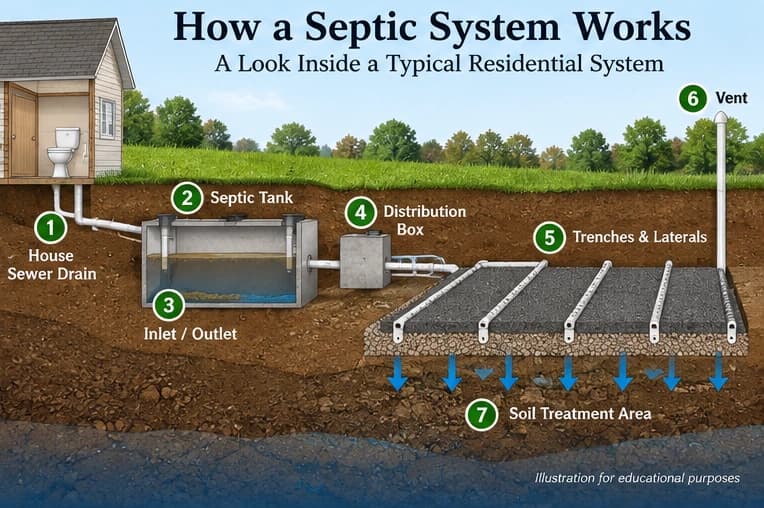
Concise descriptions paraphrased from New York State Department of Health septic system guidance:
Collects discharges from toilets, sinks, showers, laundry, and other fixtures and connects them to the septic tank.
Holds wastewater long enough for solids to settle or float. Sludge forms at the bottom; scum forms at the top; partially treated wastewater moves onward.
Septic tank replacementOpenings where wastewater enters and leaves the tank. Proper inlet/outlet arrangement supports settling and controlled outflow.
Help direct flow at the tank inlet and outlet so solids stay in the tank and clearer wastewater can move toward the field.
Splits wastewater from the tank into the absorption-field trenches as evenly as possible to reduce overloading one lateral.
Major repair guidanceReceive partially treated wastewater and distribute it through piping in the absorption area.
Trenches and distribution piping where surrounding soil biologically treats wastewater. Often includes washed gravel, stone, or an approved gravelless product.
Leach-field replacementLets plumbing gases exit the system instead of building up in the plumbing network.
Not part of every system. Where present, effluent pumps and alarms need regular inspection and maintenance.
If evaluation points to the tank, see septic tank replacement.
If the absorption field is the concern, see leach-field replacement.
If distribution or related components appear involved, see major septic system repair.
If the whole system is in doubt, start with repair vs. replacement.
How It Works explains the wastewater path and how the parts interact over time.
This components page is a labeled reference: what each physical piece is, what it does, and where to go if that piece becomes the decision focus.
Component definitions are paraphrased from New York State Department of Health septic system operation and maintenance guidance.
New York State Department of Health
Publication: Septic System Operation and Maintenance
Brookhaven Septic is not affiliated with the New York State Department of Health. Guidance below follows publicly available NYSDOH homeowner information and should be verified against current official materials.
Open the official NYSDOH publication
NYSDOH Find Out More contacts listed on the publication: health.ny.gov/DrinkingWater · Local health department contacts · (518) 402-7650
The tank separates solids and begins treatment. The leach (absorption) field distributes partially treated wastewater into trenches where soil continues treatment. They are different parts of one system.
A distribution box is part of a typical gravity system described in NYSDOH guidance. Pumps and alarms appear only on some systems. Site-specific design determines what is present.
Use the signs-of-problems routing page, or call if you need help connecting symptoms to the next evaluation step.