
How a Septic System Works
A septic system treats household wastewater on the property. Understanding the path that wastewater takes makes it easier to recognize which part may be involved when something goes wrong.
This overview paraphrases New York State Department of Health homeowner guidance for a typical onsite wastewater treatment system.
Educational septic system diagram
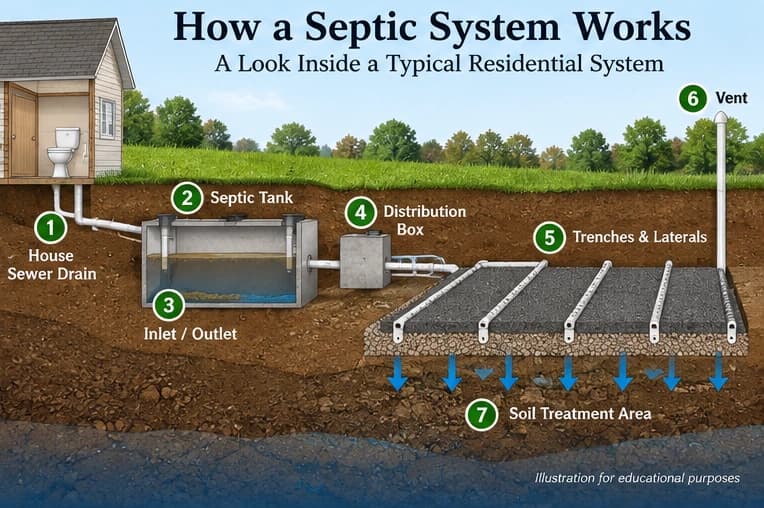
The Wastewater Path
In a typical system, household wastewater moves through these stages:
- House
- House sewer drain
- Septic tank
- Distribution box
- Trenches / laterals
- Absorption / leach field
- Soil treatment
A vent allows plumbing gases that build up in the system to exit.
House Sewer Drain
The house sewer drain collects wastewater from toilets, sinks, showers, laundry, and other fixtures and carries it to the septic tank.
Everything that leaves indoor plumbing enters the system at this point—which is why what goes down household drains matters for long-term performance.
Septic Tank
The septic tank receives household wastewater and gives solids time to settle or float.
Heavier solids settle and form sludge at the bottom. Lighter solids, fats, and grease rise and form a scum layer near the top. Between those layers, partially treated wastewater can move toward the absorption field.
Baffles at the inlet and outlet help control how wastewater enters and leaves the tank. A secured access cover protects the tank opening.
Distribution Box
After the tank, wastewater typically reaches a distribution box. The box’s job is to send flow evenly into the pipes that serve the absorption-field trenches.
Balanced distribution helps keep one part of the field from being overloaded while another part stays underused.
Trenches, Laterals, and the Absorption Field
Trenches and laterals receive partially treated wastewater from the distribution box.
The absorption—or leach—field is the network of trenches and distribution piping where surrounding soil continues biological treatment. Fields are commonly built with washed gravel, stone, or an approved gravelless product and must be properly sized, constructed, and maintained.
Soil treatment is the final stage in a typical onsite system: the ground around the field further treats wastewater as it moves through the soil.
Vent
A vent allows gases that build up in household plumbing and the septic system to exit safely. It is part of how the overall plumbing network manages air and gas movement.
Why the Failed Component Matters
A septic system is not one single object. Different parts can cause similar symptoms—or very different ones.
A tank problem does not automatically mean the drain field failed. A drain-field problem does not necessarily mean the tank needs replacement. A distribution-box or piping issue may create different repair possibilities than a failed absorption area.
Separating those questions is the practical next step after understanding how the system works.
- Tank concerns → start with tank-versus-field evaluation
- Field concerns → consider absorption-area performance
- Limited component issues → major repair may still be realistic
- Multiple failures → replacement may enter the discussion
Useful next reads: tank vs. drain-field failure, repair vs. replacement, major septic repair, and system replacement.
Official New York State Resource
These component descriptions follow New York State Department of Health guidance on septic system operation and maintenance.
New York State Department of Health
Publication: Septic System Operation and Maintenance
Brookhaven Septic is not affiliated with the New York State Department of Health. Guidance below follows publicly available NYSDOH homeowner information and should be verified against current official materials.
Open the official NYSDOH publication
NYSDOH Find Out More contacts listed on the publication: health.ny.gov/DrinkingWater · Local health department contacts · (518) 402-7650
Related Homeowner Resources
Frequently Asked Questions
Does every septic system look exactly like this?
No. A typical system in New York State Department of Health homeowner guidance has a tank, distribution, and an absorption area. Some properties also have a pump, an alarm, or a different design.
If wastewater backs up in the house, does that prove the leach field failed?
Not by itself. Backups and slow drains can involve plumbing, the tank, distribution components, or the absorption field. Symptoms are signals to investigate—not proof of one specific failure.
Not Sure What Part of Your Septic System Is Failing?
Understanding the wastewater path is the first step. If symptoms are already present, connect the next decision resource—or call for help.